
Decoding Your Appetite Part 1:
Is It Real Hunger or Just Stress?
Have you ever found yourself standing in front of an open refrigerator late at night, staring blankly at the shelves, hunting for something—anything—to eat, even though you finished dinner just two hours ago?
If so, you are in very good company. Some emotional eating experts see clients every day who feel deeply frustrated with their relationship with food. They often say "I just don’t have willpower." But here’s the truth: it’s rarely a lack of willpower. More often, it’s a breakdown in communication between your mind and your body.
Your body uses hunger as a signaling system, but stress, anxiety, boredom, and habit can easily hijack that signal. Learning to distinguish between physical hunger and emotional hunger is the single most transformative step you can take toward intuitive, peaceful eating.
What Does Real Physical Hunger Actually Feel Like?
Physical hunger—often called stomach hunger—is your body’s biological request for energy. It develops gradually as your stomach empties and your blood sugar drops.
Unlike emotional urges, physical hunger gives you clear, bodily warning signs:
A hollow, rumbling, or growling stomach: This is the classic physiological signal as stomach muscles contract.
A gradual dip in physical energy: You might feel a gentle fatigue, slight brain fog, or difficulty concentrating.
A slight lightheadedness or headache: Occurs when your blood glucose levels drop after several hours without food.
Openness to a variety of foods: When physically hungry, a balanced meal of protein, veggies, and complex carbs sounds appealing. You aren't fixation-locked on one specific junk food.
A feeling of satisfaction when full: As your stomach fills, physical satiety signals kick in, making it easy to stop eating.
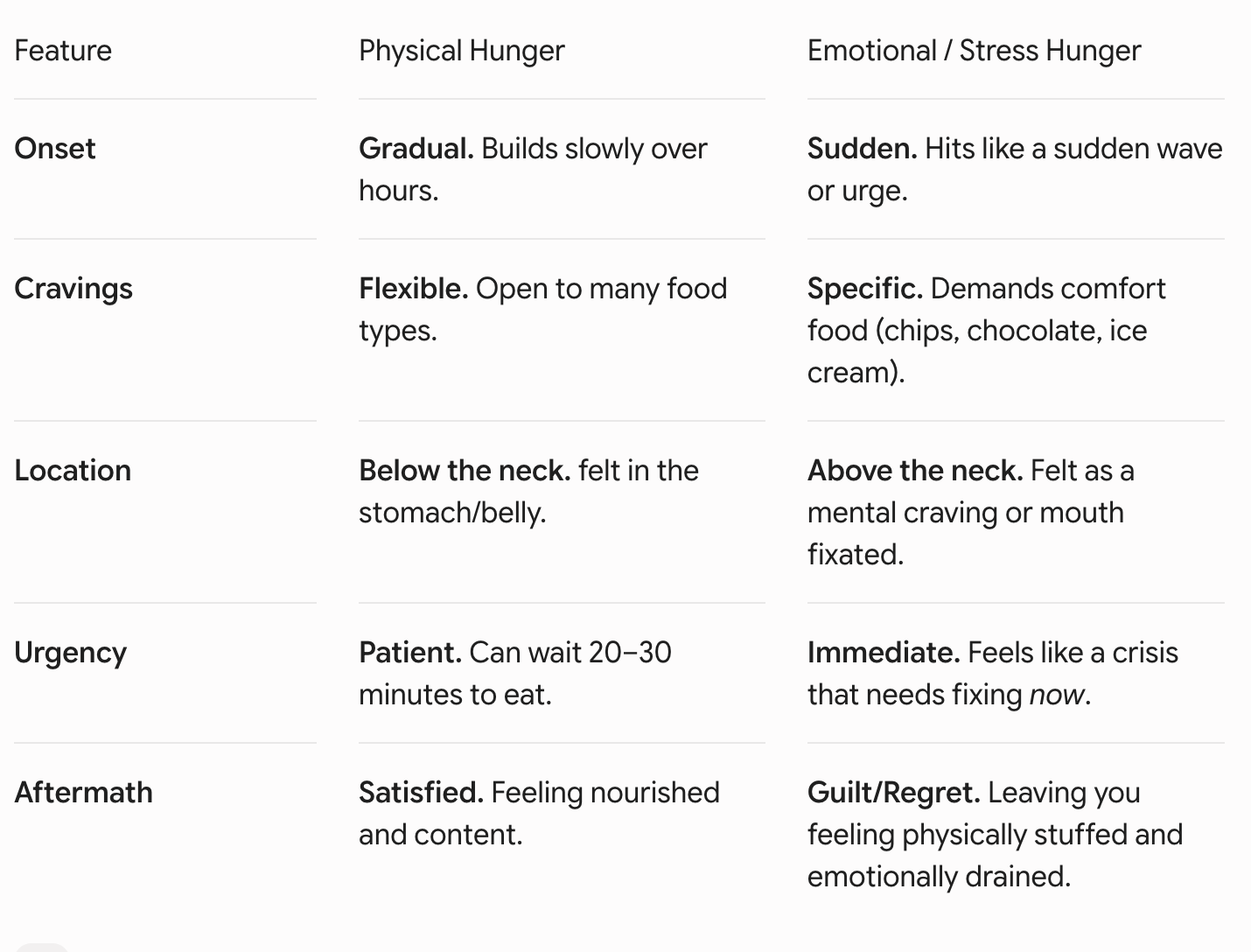
Physical vs. Emotional Hunger: The Key Differences
When stress or strong emotions hit, your body releases cortisol, which can trigger quick cravings for fast-energy foods (typically high-fat, high-sugar, or high-carb).
Here is how to spot the difference at a glance:
3 Quick Tools to Recognize the Difference in the Moment
When you feel an intense urge to head to the pantry, pause and run through these brief checks:
1. The "Apple Test"
Ask yourself: "Would I eat a fresh, plain apple (or a hard-boiled egg) right now?"
If the answer is yes, you are likely experiencing genuine physical hunger.
If the answer is no, I only want chocolate/chips, you are likely experiencing an emotional craving.
2. The Body Scan (Above or Below the Neck?)
Close your eyes for five seconds and ask: Where am I feeling this hunger?
Is your stomach rumbling or feeling empty? That's physical.
Is your mind racing, your jaw tight, or your mouth craving a specific texture (crunchy, creamy)? That's emotional stress.
3. The 10-Minute Pause
Emotional hunger thrives on urgency—it wants satisfaction immediately. Tell yourself: "I can have that snack if I still want it in 10 minutes, but first I'm going to step away and drink a glass of water." Nine times out of ten, the emotional wave will peak and pass once the immediate trigger softens.
What to Do Instead of Eating Your Feelings
You cannot fix an emotional problem with a physical solution like food. Instead of beating yourself up when emotional hunger strikes, match the craving to what your mind and body are actually asking for:
If you are stressed or overwhelmed: Your body wants soothing. Try 2 minutes of box breathing (inhale 4s, hold 4s, exhale 4s, hold 4s), take a warm shower, or go for a brief 5-minute walk outside to lower cortisol.
If you are bored or restless: Your brain wants stimulation or dopamine. Do something engaging with your hands—doodle, listen to a podcast, stretch, or call a friend.
If you are exhausted: Your body wants rest, not sugar. Give yourself permission to lie down, close your eyes for 15 minutes, or get to bed early.
If you are lonely or sad: Your heart wants connection. Text a loved one, cuddle a pet, or journal out your thoughts instead of burying them with food.
A Gentle Reminder
Overcoming emotional eating isn't about perfection; it's about curiosity over judgment. Next time you reach for food when you aren't physically hungry, don't criticize yourself. Simply pause, notice the feeling, and ask: "What do I really need right now?"
References
Fuente González, C. E., Chávez-Servín, J. L., de la Torre-Carbot, K., Ronquillo González, D., Aguilera Barreiro, M. d. l. Á., & Ojeda Navarro, L. R. (2022). Relationship between emotional eating, consumption of hyperpalatable energy-dense foods, and indicators of nutritional status: A systematic review. Journal of Obesity, 2022, 1–11. https://doi.org/10.1155/2022/4243868 Cited by: 145
Warren, J. M., Smith, N., & Ashwell, M. (2017). A structured literature review on the role of mindfulness, mindful eating and intuitive eating in changing eating behaviours: effectiveness and associated potential mechanisms. Nutrition Research Reviews, 30(2), 272–283. https://doi.org/10.1017/s0954422417000154 Cited by: 723
Interested in learning more about Emotional Eating? Check out the Overcoming Emotional Eating Podcast by Wendi Francis, MS, RD, CPC
Food Psychologist, Certified Professional Life and Business Coach and Registered and Licensed Dietitian, brings 28 years of experience, a wide variety of education, certifications and expertise to the table, as she helps clients, groups and businesses overcome emotional eating.

Eating with stress, boredom, fear, loneliness, worry, anxiety or happiness are all ways we define emotional eating. The American Psychological Association reports that almost 40% of people have eaten in response to stress in the last 30 days. You are not alone. Each week, you can join Wendi Francis, emotional eating expert, to help YOU overcome your emotional overeating. If you want to finally find freedom from your food, weight, and body this is the podcast for you. Your time to become an OVERCOMER starts now.