
Sleep Optimization: How Rest Impacts Cortisol and Your Fat-Burning Potential
We’ve all been there: you’re hitting the gym, meal prepping like a pro, and staying hydrated, but the scale isn't budging. If you’re doing "everything right" but still feeling stuck, the missing link might not be what you’re doing during the day—it’s what you’re not doing at night.
Weight loss isn't just a matter of "calories in vs. calories out." It is a hormonal symphony, and the conductor of that symphony is your sleep. Specifically, the relationship between sleep quality, cortisol, and metabolic efficiency determines whether your body is in "storage mode" or "burn mode."
The Cortisol Connection: Your Body’s Stress Alarm
Cortisol is often labeled the "stress hormone," but it’s actually essential for life. It follows a circadian rhythm—a natural internal clock that dictates your energy levels throughout a 24-hour cycle.
The Morning Spike: Under normal conditions, cortisol should be at its highest about 30 minutes after you wake up (the Cortisol Awakening Response). This gives you the alertness needed to start the day.
The Daytime Decline: Ideally, levels gradually taper off throughout the afternoon.
The Nighttime Low: By the time you head to bed, cortisol should be at its lowest point, allowing its "sleepy" counterpart, melatonin, to take over.
The Problem: When you are sleep-deprived, this rhythm breaks. Your body perceives a lack of rest as a threat, keeping cortisol levels chronically elevated. High evening cortisol inhibits the release of growth hormone—the very hormone responsible for tissue repair and fat metabolism.
How Elevated Cortisol Blocks Fat Loss
When cortisol stays high due to poor sleep, it triggers a domino effect in your biology:
Insulin Resistance: High cortisol signals the liver to release glucose for "energy" (the fight-or-flight response). This spikes insulin, which is your primary fat-storage hormone.
Muscle Breakdown: Cortisol is catabolic, meaning it can break down muscle tissue for energy, slowing your metabolism.
Increased Cravings: Sleep deprivation lowers leptin (the "full" hormone) and raises ghrelin (the "hunger" hormone), specifically making you crave high-carb, high-sugar foods.
Calming the Nervous System: The Ultimate Bedtime Routine
To drop your cortisol levels and enter a fat-burning state, you must transition your nervous system from Sympathetic (Fight or Flight) to Parasympathetic (Rest and Digest).
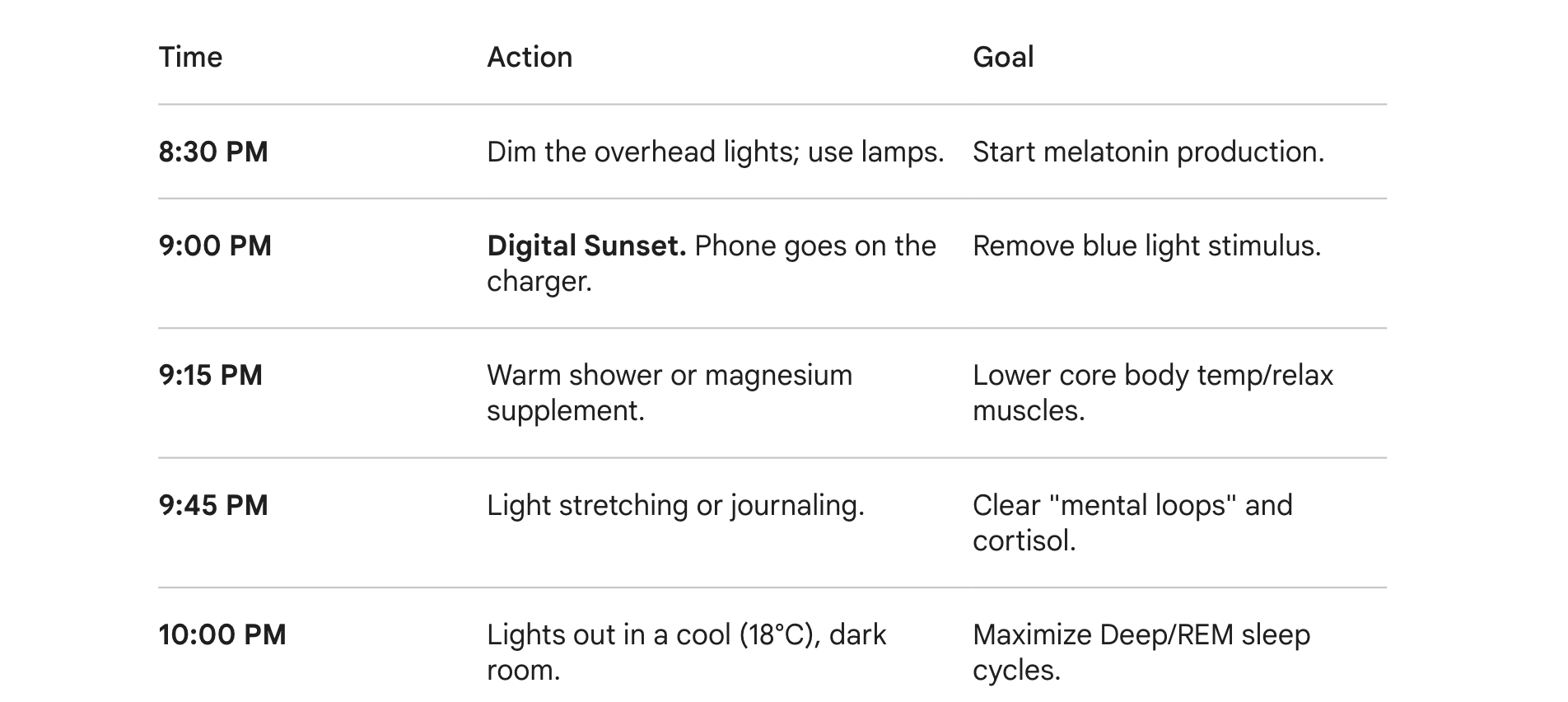
1. The "Digital Sunset"
The blue light from your phone mimics sunlight, tricking your brain into thinking it’s still daytime and suppressed melatonin.
The Rule: Stop scrolling at least 60 minutes before bed.
The Alternative: Swap the phone for a physical book, a journal, or an audiobook.
2. Temperature Regulation
Your core body temperature needs to drop by about 1° to 2° to initiate deep sleep.
The Routine: Take a warm bath or shower an hour before bed. When you step out, your body temperature will rapidly drop, signaling to your brain that it’s time to sleep.
3. Nervous System Down-Regulation
Try the 4-7-8 Breathing Technique to manually flip the switch on your stress response:
Inhale through the nose for 4 seconds.
Hold your breath for 7 seconds.
Exhale forcefully through the mouth for 8 seconds.
Sample "Metabolic Recovery" Nightly Schedule
_
The Bottom Line
You cannot out-train a lack of sleep. By prioritizing a consistent bedtime and calming your nervous system, you aren't just "resting"—you are optimizing your hormones to work for you rather than against you. True fat loss happens when your body feels safe enough to let go of its energy stores.
Sources:
Harvard Health Publishing: "Sleep, Stress, and Cortisol"
The Journal of Clinical Endocrinology & Metabolism: "Impact of Sleep Deprivation on Metabolic Health"
Sleep Foundation: "The Connection Between Sleep and Weight Loss"
Mayo Clinic: "Chronic Stress and the Cortisol Effect"